 Learn Me AI
AI With Citations: Grounded Answers You Can Trust
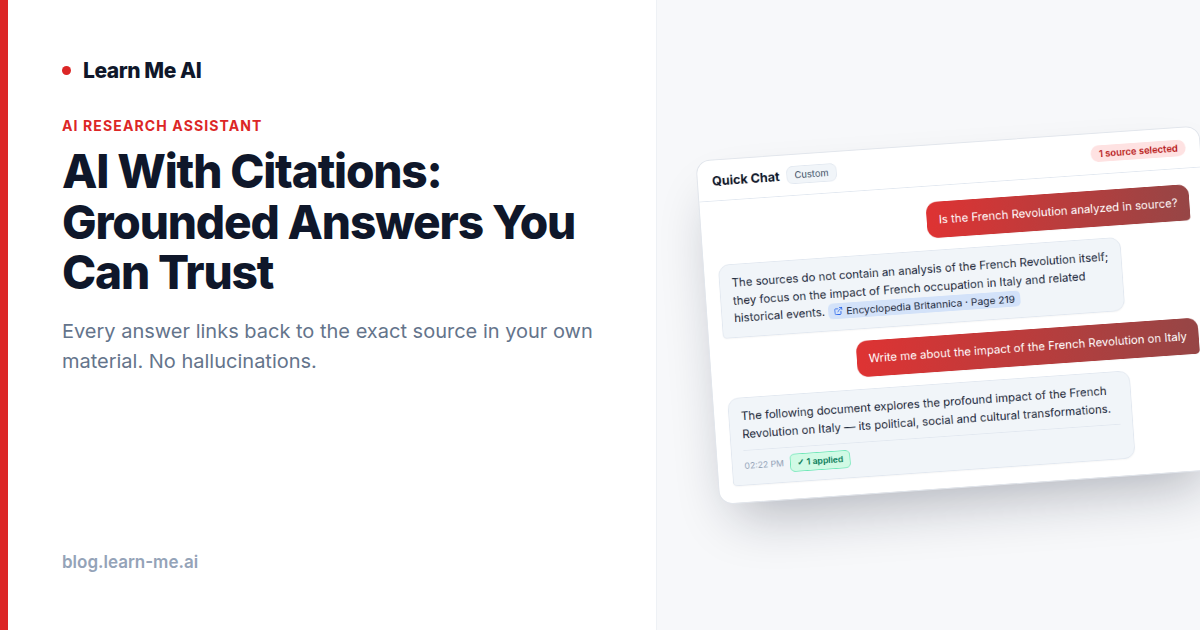
AI with citations is no longer a nice-to-have — it is the difference between research you can trust and research you have to double-check from scratch. Most general-purpose chatbots will happily answer any question, but they pull from a fuzzy blend of training data and pattern-matching. Sometimes they are right. Sometimes they confidently make things up, and occasionally they even invent realistic-looking citations to sources that do not exist. If you are doing real work, “sounds plausible” is not good enough. You need to know where an answer came from. That is exactly what Learn Me AI is built to deliver: cited, grounded answers, every time.
The hallucination problem with generic AI
It is widely known by now that large language models can hallucinate — they produce fluent, confident text that is simply not true. This is not a rare edge case; it is a fundamental property of how generic models work. They are trained to predict likely-sounding language, not to tell you the truth about your documents.
The most dangerous version of this is the fabricated citation. A model tells you “According to a 2021 study” and gives you an author, a journal, and a page number — and none of it is real. For a student, an analyst, or a journalist, repeating one of these invented facts can be reputation-ending. The core problem is that a generic chatbot has no obligation to anchor its answer to anything you can check.
How AI with citations works in Learn Me AI
Learn Me AI flips the model around. Instead of answering from the open internet or hazy training memory, it answers only from the sources you upload. You build one searchable knowledge base out of your own material — PDFs, plain text, audio that gets automatically transcribed and made searchable, web pages, and YouTube videos — and then you chat across all of it at once.
Every answer is grounded in that knowledge base, and every answer links back to the exact source it came from. This is what source-grounded AI means in practice: the response is not a guess assembled from the model’s general knowledge — it is drawn from passages in your files, with a citation pointing straight back to them. If the answer references a claim, you can click through and read the original sentence that supports it.
The positioning is simple: chat with your sources, get cited answers, publish the result. Because the model is constrained to your material, it cannot wander off and invent a study that does not exist in your knowledge base. The citation is not decoration — it is the proof.
Who needs cited, source-grounded AI
Anyone whose work depends on being right benefits from cited AI answers, but a few groups feel it most:
- Researchers and academics who need to trace every claim back to a primary source and cannot afford a fabricated reference slipping into their work.
- Analysts synthesizing reports, market scans, or competitive intelligence from dozens of documents, where one wrong figure can mislead a decision.
- Content and editorial teams who are publishing externally and need every statement to be defensible and attributable.
- Anyone publishing — once an answer leaves your screen and goes out under your name, you own its accuracy. Grounded citations let you stand behind every word.
If you regularly run topic research and monitoring across a growing pile of material, the citation trail is what keeps that research auditable as it scales.
How to verify every answer
The point of AI with citations is that you do not have to take the model’s word for it. Verification is built into the workflow:
- Read the linked source. Each answer links back to the exact source it came from, so you can open the original passage and confirm the claim in context.
- Check it against your own material. Because answers come only from your uploaded sources, you already know the provenance — there is no mystery third-party data to chase down.
- Spot the gaps. If your knowledge base does not contain support for a question, a grounded system has nothing to cite — which is far safer than a generic model confidently filling the gap with fiction.
This is the habit that makes research trustworthy: never publish a claim you have not clicked through and seen for yourself. With grounded citations, that click is one step away.
Why this beats a generic chatbot
A generic chatbot optimizes for a confident-sounding answer. Source-grounded AI optimizes for an answer you can prove. That is a different goal, and it produces a fundamentally different result:
- Provenance over plausibility — answers trace back to a specific source instead of a black box.
- Your sources, not the whole internet — no scraping in irrelevant or unreliable material you never approved.
- Verifiable, not just convincing — you can confirm each response rather than hoping it is correct.
- Built to publish — when your answers are grounded and cited, you can move from research straight to a finished post in WordPress or Ghost without a separate fact-checking pass.
An AI that doesn’t hallucinate about your material is not a magic trick — it is the natural outcome of restricting answers to sources you control and showing the receipts every time.
Frequently asked questions
Does AI with citations mean it never makes a mistake?
No tool can promise perfection, but grounding dramatically reduces the risk. Because Learn Me AI answers only from your uploaded sources and links each answer back to the exact source, you can verify any claim yourself instead of trusting it blindly. The citation is there precisely so you can check.
Where do the answers come from?
From your own knowledge base — the PDFs, text, audio, web pages, and YouTube videos you upload. Learn Me AI does not answer from the open web or generic training data; it gives source-grounded answers drawn from your material, with citations pointing back to it.
How do I check where an answer came from?
Every answer links back to the exact source it came from. You click the citation, read the original passage in your own sources, and confirm the claim in context. Verification takes seconds, not a separate research session.
Is it really free to try?
Yes. There is a free plan and no credit card is required to start building a knowledge base and getting cited AI answers.
Try Learn Me AI free
Turn your PDFs, audio, web pages and YouTube videos into one AI you can chat with — get cited answers and publish the result. No credit card needed.
Get started free →Keep reading
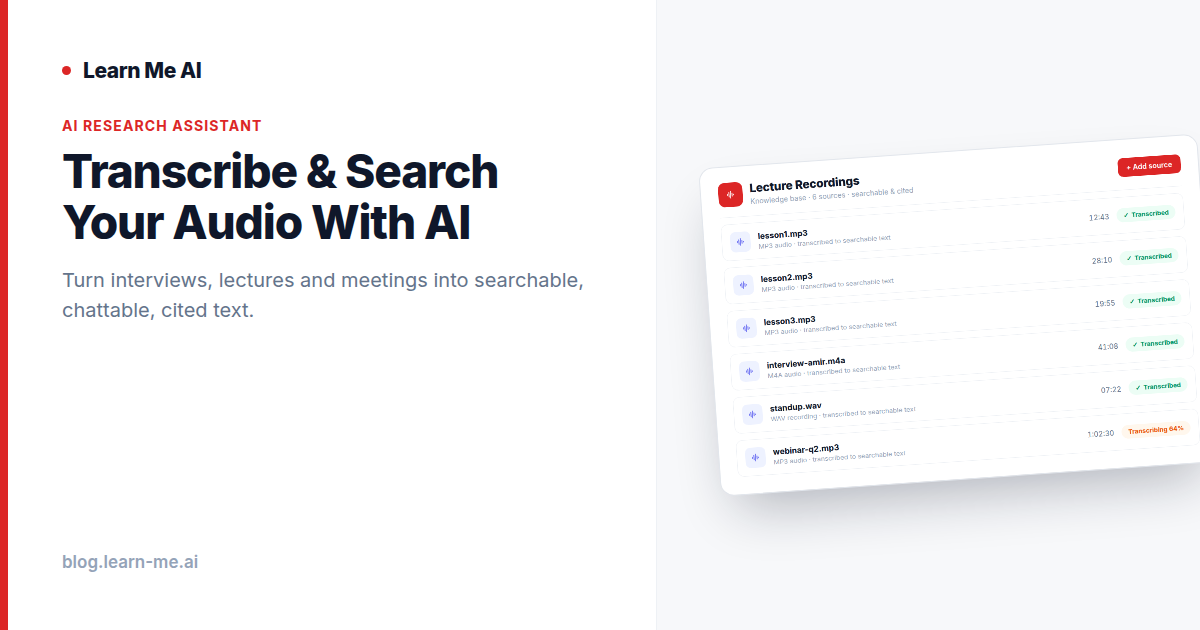
Transcribe and Search Audio With AI Instantly
Transcribe and search audio with AI: turn interviews, lectures and meetings into searchable, chattable text with cited answers. Free, no credit card.
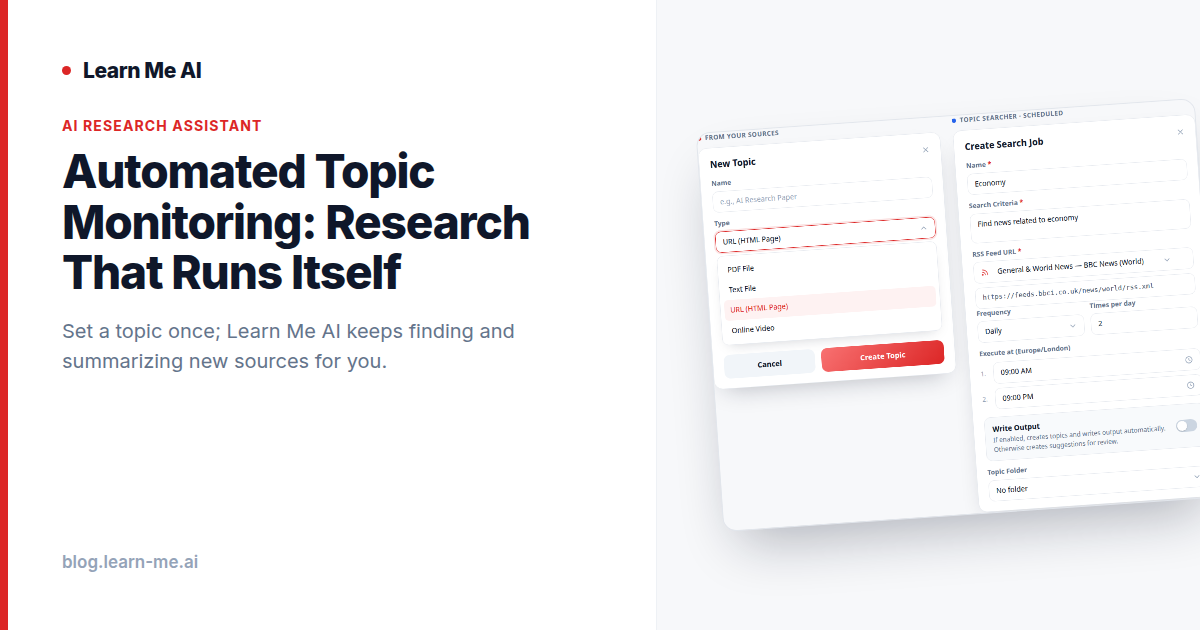
Automated Topic Monitoring: Research That Runs Itself
Automated topic monitoring keeps your knowledge base current. Track a subject, let AI pull fresh articles and videos on a schedule, then analyze it in chat.
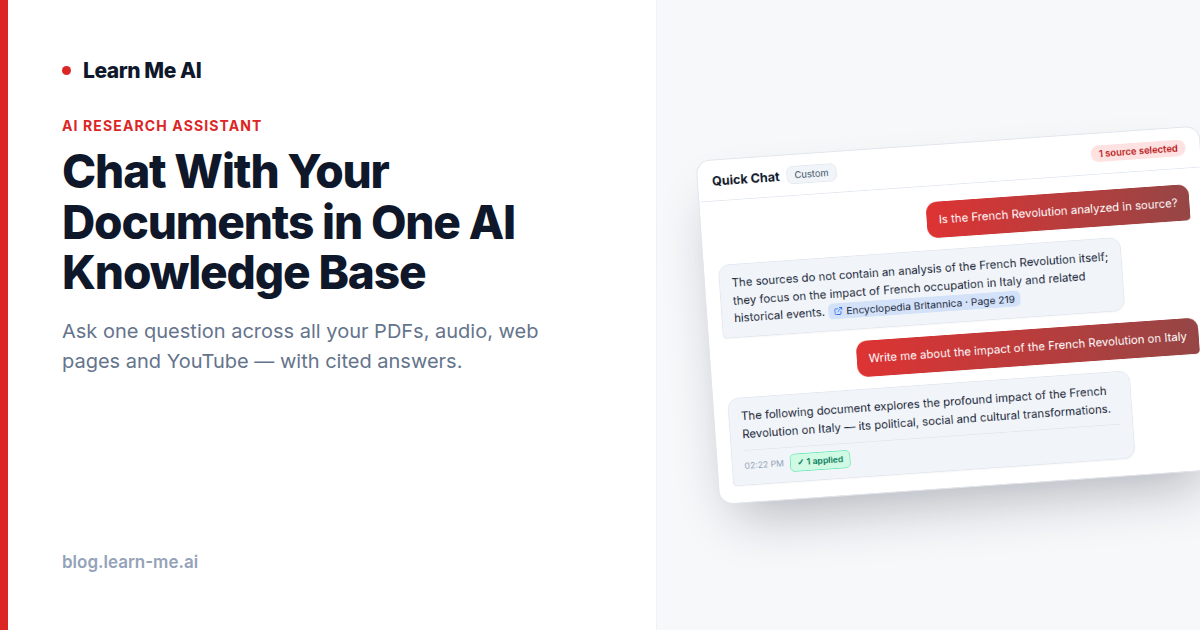
Chat With Your Documents in One AI Knowledge Base
Chat with your documents across PDFs, audio, web pages and YouTube in one AI knowledge base. Ask once, get cited answers from all your sources at once.